Client Engagement

The AI recommends them. It just never brings them up.

Ask ChatGPT about Endo45 by name and it ranks them first in 96% of answers. Ask it anything about managing endometriosis and they do not appear at all. Sixteen weeks working out why, and what to do about it.

Role
Digital Growth Consultant — Integrated Industry Project
Timeframe
May – Aug 2026 · 16 weeks · ~256 hours
Supervisor
Client: Juliet Oliver, Founder, Endo45 · Academic: Dr Lily Wisker, EIT
Deliverables
Digital audit report, SEO / AEO strategy, UX design brief, Growth strategy paper, Final integrated report and KPI framework
Client
Endo45
Client contact
Juliet Oliver, Founder
Academic supervisor
Dr Lily Wisker, EIT
Endo45 AI visibility report showing branded and non-branded query results

8.7 yrs

Mean diagnostic delay for endometriosis in New Zealand

Tewhaiti-Smith et al., 2022

17

Domain Authority Score, against 40–80 for established health publishers

SEMrush, 28 Jun 2026

0

AI Visibility score on non-branded queries

SEMrush AI Visibility, ChatGPT, 28 Jun 2026

The Client

A platform built from an eight-year wait.

Endo45 is a practitioner-reviewed self-management platform for people with endometriosis, built by Juliet Oliver out of her own experience of misdiagnosis and delay. The condition affects around one in ten women and people assigned female at birth in New Zealand, and the mean diagnostic delay here is 8.7 years.

The platform is not the problem. Its content is reviewed by qualified practitioners, its positioning is clear, and its audience is real and underserved. What it lacks is the infrastructure that lets any of that be found — and it lacks it at exactly the moment discovery is moving from search results to generated answers.

The Finding

One chart carries the whole engagement.

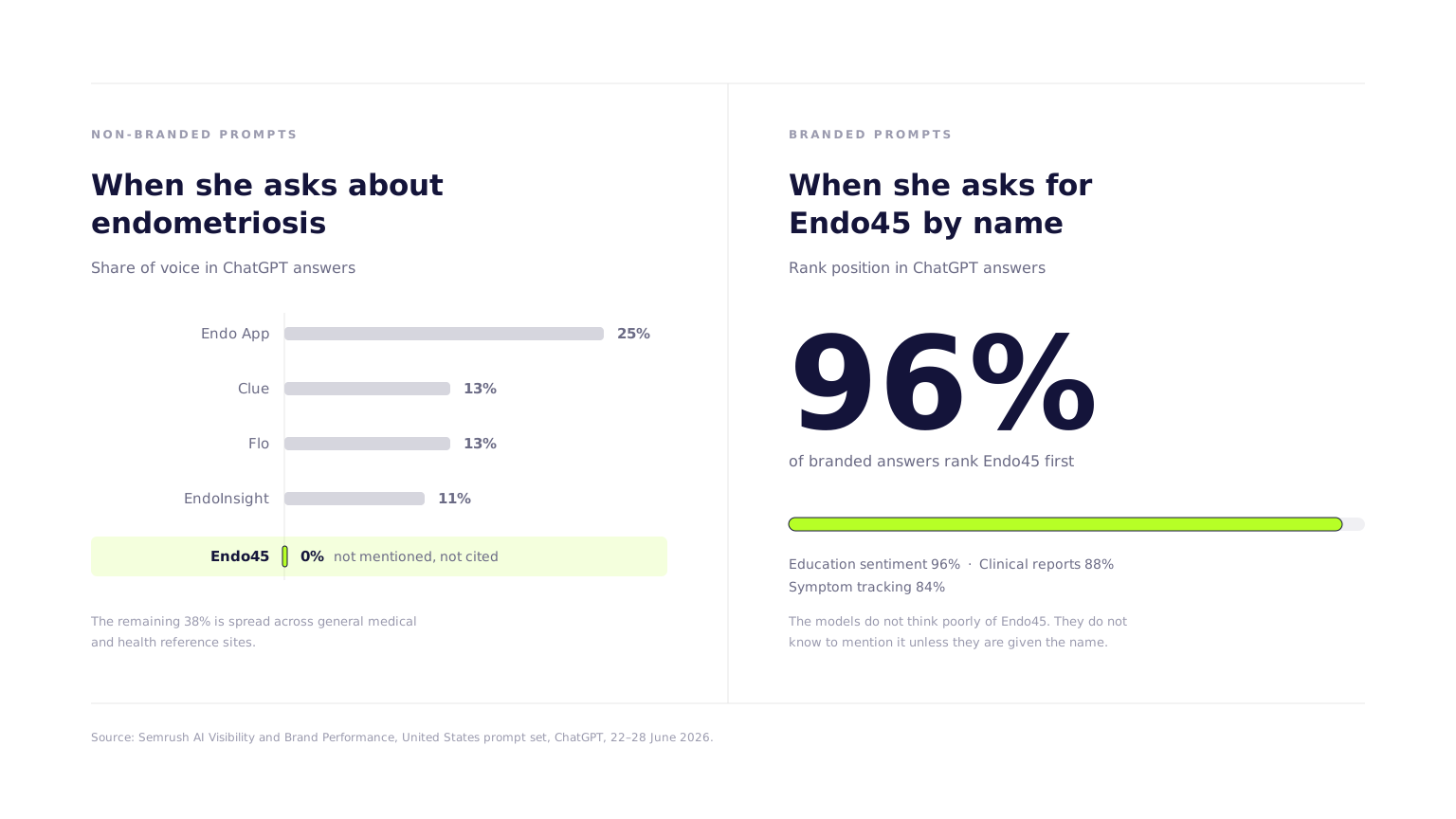
Same platform, same answer engine, same day. The only variable is whether the question says the brand name.

Endo45 visibility in AI answers, branded vs non-branded queries

When the prompt names Endo45, it is returned first in 96% of answers with the highest content sentiment in the competitive set. When the prompt asks a general endometriosis question, share of voice is zero.

How this was measured

SEMrush AI Visibility, ChatGPT, US English, 28 June 2026. The 96% is a position metric over a small brand-seeded prompt set run by the vendor, not an independently replicated experiment. It says nothing about how often the brand comes up in the wider market — that is what the 0% measures.

Endo45 visibility in AI answers, branded vs non-branded queries
Item%
Branded prompts — ranked first96%
Non-branded prompts — share of voice0%

Strategic keyword portfolio by cluster

156 keywords retained from an initial universe of 409, mapped to 12 clusters. Almost all sit in management intent — what helps, how to manage, what causes — rather than definitional queries where institutional sites are unbeatable.

Note SEMrush Keyword Magic Tool, US database, broad match, seed term 'endometriosis', June 2026. US volumes may not represent the NZ or AU market.

Strategic keyword portfolio by cluster
Itemkeywords
Diet & Food25 keywords
Flare & Pain Management25 keywords
Natural & Lifestyle17 keywords
Gut & Bowel17 keywords
Fertility15 keywords
Supplements & Tea15 keywords
PCOS & Endometriosis9 keywords
Fatigue & Energy9 keywords
Hormones7 keywords
Weight & Body7 keywords
Remission & Hope5 keywords
Mental Health & Stress5 keywords
The Reframe

Visibility as a resource, not a marketing spend.

I ran the engagement through the Resource-Based View and Dynamic Capabilities. That sounds like academic scaffolding and it changed the recommendations materially.

Under RBV, the question is not which tactics to run but which assets compound and resist copying. Domain authority, topical depth, community trust and a longitudinal user-data asset all do. That reframes SEO and AEO spend as building something the client keeps, rather than renting attention — which is the argument that justifies deferring paid acquisition entirely while Authority Score sits at 17.

Dynamic Capabilities supplied the timing argument. The move from search to answer engines is exactly the kind of environmental discontinuity where a small, fast operator can take ground before scale players consolidate. Endo45's disadvantage in size is, briefly, an advantage in speed.

The engines already trust the content. Nothing had told them where to find it.
Is the market winnable?

Four of five forces pushing hard.

Porter's Five Forces, outside-in. Structurally hostile at the generic level, defensible for a differentiated specialist.

  • Threat of new entrants

    High

    Stable

  • Bargaining power of buyers

    High

    Increasing

  • Bargaining power of suppliers

    Medium

    Increasing — AI platforms gaining control of discovery

  • Threat of substitutes

    High

    Sharply increasing — generative AI replacing the education layer

  • Competitive rivalry

    High

    Sharply increasing — Flo's vertical entry into endometriosis, 2026

Note Phase 1 competitor analysis, May 2026. Pressure ratings are analytical judgements from the audit evidence, not measured quantities.

Can Endo45 win it?

Eight resources. Two that hold.

VRIO, inside-out. Paired with Porter because one lens alone systematically hides what the other sees.

  • VValuable
  • RRare
  • Icostly to Imitate
  • OOrganised to capture value
  • yes
  • partial
  • no

Founder lived-experience narrative

Valuable
Rare
costly to Imitate
Organised to capture value

Sustained advantage (latent)

EndoFit™ Score

Valuable
Rare
costly to Imitate
Organised to capture value

Temporary → sustained with action

NZ-anchored brand presence

Valuable
Rare
costly to Imitate
Organised to capture value

Temporary advantage

Agile small-team capability

Valuable
Rare
costly to Imitate
Organised to capture value

Temporary advantage

Structured 45-day programme

Valuable
Rare
costly to Imitate
Organised to capture value

Competitive parity

Multidisciplinary practitioner network

Valuable
Rare
costly to Imitate
Organised to capture value

Competitive parity

Subscription content library

Valuable
Rare
costly to Imitate
Organised to capture value

Parity — AEO upside

Practitioner-reviewed evidence base

Valuable
Rare
costly to Imitate
Organised to capture value

Emerging disadvantage

Note Both sustained-advantage resources were under-exploited organisationally — which is why the homepage redesign recommendation exists.

The Audit

Healthy on paper, unreadable to machines.

Site Health scored 81% and AI Search Health 78%, which reads fine until you go page by page. Of 33 pages crawled, exactly one was fully clean. Twenty-seven carried at least one issue, four were redirects and one was broken — 16 errors and 54 warnings in total.

The specifics mattered more than the score: 12 duplicate title tags, 20 pages with no meta description, 17 pages with multiple H1s, and 660 links carrying no anchor text. No llms.txt at the root and no schema anywhere, which means nothing on the site told an answer engine what kind of content it was looking at or who had reviewed it.

One finding cut against the gloom. Across a seven-day Australian position-tracking campaign on 21 keywords, visibility rose 9.29 percentage points to 14.66% — driven almost entirely by a single fatigue-and-caffeine cluster and largely one page. Small, caveated, and the first evidence that this content ranks when it targets the right kind of query.

Two Rooms

What I found, and what I told them to do.

Five phases, five milestone reviews. Each closed with one of these two conversations.

The problem is infrastructure, not audience.

What went to the client at each phase review. Findings were reported separately from interpretation so they stay stable as the data refreshes.

  • Answer engines rate the content highly when prompted by name and never surface it otherwise
  • All 21 tracked keywords returned a Google AI Overview; three already cited Endo45; no featured snippets fired at all
  • 156 winnable keywords sit in management intent, where institutional authority counts for less
  • Only the founder narrative and the EndoFit™ Score survive VRIO as sustained advantages, and neither is used on the homepage
The Method

Stated as hypotheses, not promises.

Each one names what was measured, who owns it, when it lands, and the threshold that decides whether it worked.

Stated as hypotheses. Outcomes are measurable only after implementation.

Fix the technical and metadata foundation

Hypothesis

Resolving crawl and metadata defects removes a structural obstacle to both traditional ranking and AI crawlability.

Baseline
16 errors, 12 duplicate title tags, 20 pages without meta descriptions, 660 links with no anchor text, Site Health 81% (28 Jun 2026)
Owner
Endo45 — founder / developer
Timeframe
Months 1–3, as a precondition for everything else
Success measure
Site Health ≥ 90%, zero duplicate-title and missing-metadata errors on re-crawl, anchor-text issues reduced by ≥ 80%

Build the AEO infrastructure

Hypothesis

Giving answer engines an identifiable, structured source for the brand will surface Endo45 on non-branded queries.

Baseline
AI Visibility 0, non-branded share of voice 0%, no llms.txt, no schema, 4 pages cited (28 Jun 2026)
Owner
Endo45 — founder / developer, with content input
Timeframe
Shipped Months 1–3, effect expected Months 3–6
Success measure
llms.txt live and schema validating on key pages; at least one non-branded query returning an Endo45 mention; cited pages above the current 4 by Month 6

Publish against the winnable clusters

Hypothesis

Low-difficulty, high-intent queries will gain traction early and reinforce each other.

Baseline
156-keyword architecture; 43 keywords at KD ≤ 10 representing roughly 8,680 monthly US searches (28 Jun 2026)
Owner
Endo45 — founder, single-author cadence
Timeframe
Quick wins Months 1–3, pillar clusters Months 4–6
Success measure
At least 9 target articles published and indexed by Month 3; measurable ranking movement into the top 20 for at least 5 target keywords by Month 6

Rebuild the homepage around the founder and the EndoFit™ Score

Hypothesis

Foregrounding the two resources VRIO identified as under-exploited closes the organisation gap and lifts conversion.

Baseline
Homepage is symptom-led rather than founder-led; ~376 visits / 297 unique, 2.21 pages per visit, 2m 07s average (SEMrush Traffic Analytics, May 2026)
Owner
Endo45 — founder
Timeframe
Months 4–6
Success measure
One primary CTA and a founder-story section live; measurable improvement in pages per visit against a re-based figure once GA4 replaces the unreliable bounce metric

Apply chronic-health UX standards site-wide

Hypothesis

Lower cognitive load, no fear-based design, and visible trust signals help rather than harm a fatigued YMYL audience.

Baseline
No heuristic evaluation performed; trust signals — named reviewer, review date, clinical-complement disclaimer — not systematically present (28 Jun 2026)
Owner
Endo45 — founder / content
Timeframe
Months 1–6, applied as each page is built or updated
Success measure
Every content page carries a named practitioner reviewer, review date and disclaimer; one CTA per page; zero severity-3+ usability issues on the core journey

Build an owned-audience engine

Hypothesis

Gating the two existing lead magnets and nurturing subscribers converts volatile, borrowed search reach into durable owned reach.

Baseline
No email capture in place; most traffic arriving on a single caffeine/fatigue page; two lead magnets published but ungated (28 Jun 2026)
Owner
Endo45 — founder
Timeframe
Months 4–6
Success measure
Opt-in live behind both lead magnets with a nurture sequence running, and a subscriber count and opt-in rate established as a new baseline by Month 6 — set after a month of data, not pre-committed
The Engagement

Five phases, sixteen weeks.

Each closed with a milestone deliverable and a joint review before the next began.

  1. Weeks 1–3

    Phase 01

    • Digital audit of endo45.co.nz
    • Competitor benchmarking
    • Keyword research and intent classification
    • Deliverable: audit report and competitor analysis
  2. Weeks 4–6

    Phase 02

    • Keyword-cluster framework
    • On-page SEO standard against E-E-A-T and YMYL
    • AEO targeting plan for snippets, AI Overviews and conversational queries
    • Deliverable: SEO / AEO strategy document
  3. Weeks 7–10

    Phase 03

    • Heuristic evaluation against Nielsen's ten principles
    • Content hierarchy mapped to awareness, consideration, conversion
    • Low-fidelity wireframes as annotated zone briefs
    • Deliverable: UX design brief
  4. Weeks 11–13

    Phase 04

    • Channel evaluation on cost, defensibility, time-to-value and capability fit
    • Engagement and retention plan
    • Funnel model
    • Deliverable: growth strategy paper
  5. Weeks 14–16

    Phase 05

    • Leverage / effort / dependency prioritisation
    • Three-horizon roadmap
    • Four-dimension KPI framework with documented baselines
    • Deliverable: final integrated report
The Measurement

Every target hangs off a documented baseline.

Set against a realistic single-author publishing cadence and the time new content needs to rank and be absorbed by AI models.

Discoverability

Organic keywords (US)

Baseline
17
Target · 6 months
≥ 120
Target · 12 months
≥ 250

Discoverability

Authority Score

Baseline
17
Target · 6 months
≥ 25
Target · 12 months
≥ 30

AI Visibility

AI Visibility score

Baseline
0
Target · 6 months
≥ 10
Target · 12 months
≥ 25

AI Visibility

ChatGPT share of voice

Baseline
0%
Target · 6 months
≥ 8%
Target · 12 months
≥ 15%

Technical

Site Health

Baseline
81%
Target · 6 months
≥ 95%
Target · 12 months
≥ 95%

Technical

Pages with schema

Baseline
0
Target · 6 months
≥ 25
Target · 12 months
≥ 45

Engagement

Content pages published

Baseline
6
Target · 6 months
≥ 40
Target · 12 months
≥ 70

Engagement

Email list size

Baseline
0
Target · 6 months
≥ 1,000
Target · 12 months
≥ 3,000

Note Target columns are intentions set against the documented baseline, not results.

The Posture

Where to spend, and where not to.

Ranked by what compounds and what Endo45 is structurally able to run.

  • Core

    Organic SEO

    Compounds over time; the 156-keyword architecture is already built

  • Core

    AEO / AI search

    Uncontested niche and the single largest visibility gap

  • Build

    Email / owned audience

    Converts volatile borrowed traffic into durable, re-reachable reach

  • Build

    Founder-led social

    Amplifies the one resource competitors cannot imitate

  • Test

    Partnerships / referral

    Turns home-market rivalry into collaboration

  • Defer

    Paid search / social

    Authority Score 17 makes cost per acquisition punitive until conversion infrastructure exists

The Deliverables

Five documents, one argument.

Each phase closed with something the client could act on without me in the room.

Why this framework

To establish a defensible baseline before recommending anything.

What it revealed

A site scoring 81% health with exactly one clean page out of 33 — the aggregate score was hiding the distribution.

Why this framework

To convert 156 classified keywords into a publishing architecture a single author could actually run.

What it revealed

The AEO content standard — a 40–60 word direct answer, question-formatted headings, an FAQ block — is the same discipline good evidence-based health writing already requires.

Why this framework

To translate the content strategy into a page structure without pretending to a pixel-level design the budget didn't cover.

What it revealed

Delivering wireframes as annotated zone briefs rather than mock-ups was the right call — it kept the client's attention on hierarchy instead of colour.

Why this framework

To decide where a one-person team should and should not spend.

What it revealed

The most valuable recommendation in the paper was the one to not do something: defer paid entirely.

Why this framework

To leave behind something usable after the engagement ended.

What it revealed

Writing every recommendation as hypothesis, baseline, owner, timeframe and success measure forced me to drop two ideas I couldn't attach a measurement to.

What The Numbers Are Worth

Documented, not buried.

Every figure on this page came from third-party tools. These are the constraints I reported to the client alongside the findings.

  1. 01

    No first-party analytics access

    No GA4, Search Console or CRM access for the engagement. All traffic and engagement figures are SEMrush estimates and should be re-based against first-party data as the first implementation step.

  2. 02

    The 0% bounce rate is not real

    SEMrush reported a 0% bounce rate, which is behaviourally impossible. I treated it as an analytics misconfiguration to be verified rather than a finding — and did not build any recommendation on it.

  3. 03

    AI visibility is one tool, one platform, one day

    All AI figures come from SEMrush's AI Visibility toolkit on ChatGPT, US English, 28 June 2026. The prompt set is run by the vendor, not by me, so it is neither inspectable nor independently replicable. No manual cross-validation against ChatGPT, Gemini or Perplexity was performed. Treat these as informative signals that justify a tested strategy, not as measurements.

  4. 04

    US keyword data, NZ and AU audience

    Keyword volumes come from the US database. Where decisions depend on volume, they need re-checking against NZ and AU data. Australian data was prioritised in position tracking where available.

  5. 05

    No primary research with patients

    No user testing or interviews with Endo45 users. UX recommendations rest on heuristic evaluation and the published literature, and would be materially strengthened by even a small-scale usability study.

Honestly

What sixteen weeks taught me.

The hardest discipline was refusing to over-claim. It would have been easy to present the 96% as a headline win, and a client who wanted good news would have accepted it. It is a position metric on a small vendor-run prompt set, and saying so out loud made the 0% beside it far more persuasive than either number would have been alone.

The thing I would change is sequencing. I should have pushed harder for GA4 and Search Console access in week one instead of working around its absence for sixteen weeks. Third-party estimates were adequate for setting strategic direction and inadequate for setting the KPI baselines the whole roadmap now hangs from. Every one of those baselines needs re-basing before anyone measures against it — which is a caveat I wrote into the report, and would rather not have needed.

Sources

SEMrush Site Audit, Domain Overview, Position Tracking, AI Visibility and Keyword Magic Tool, June 2026, Aggarwal et al., GEO: Generative Engine Optimization, ACM SIGKDD, 2024, Tewhaiti-Smith et al., Diagnostic delay for endometriosis in Aotearoa New Zealand, Scientific Reports, 2022, Barney, Looking inside for competitive advantage, AMP, 1995, Teece, Pisano & Shuen, Dynamic capabilities and strategic management, SMJ, 1997, Nielsen, 10 Usability Heuristics for User Interface Design, NN/g, 2020, Ellis, Munro & Wood, Dismissal informs the priorities of endometriosis patients in New Zealand, Frontiers in Medicine, 2023

← Back to work

Let’s craft digital growth together.

Email

hello@vikasviradiya.com

Call Me

Social

© 2026 Vikas Viradiya — Built with intention.